
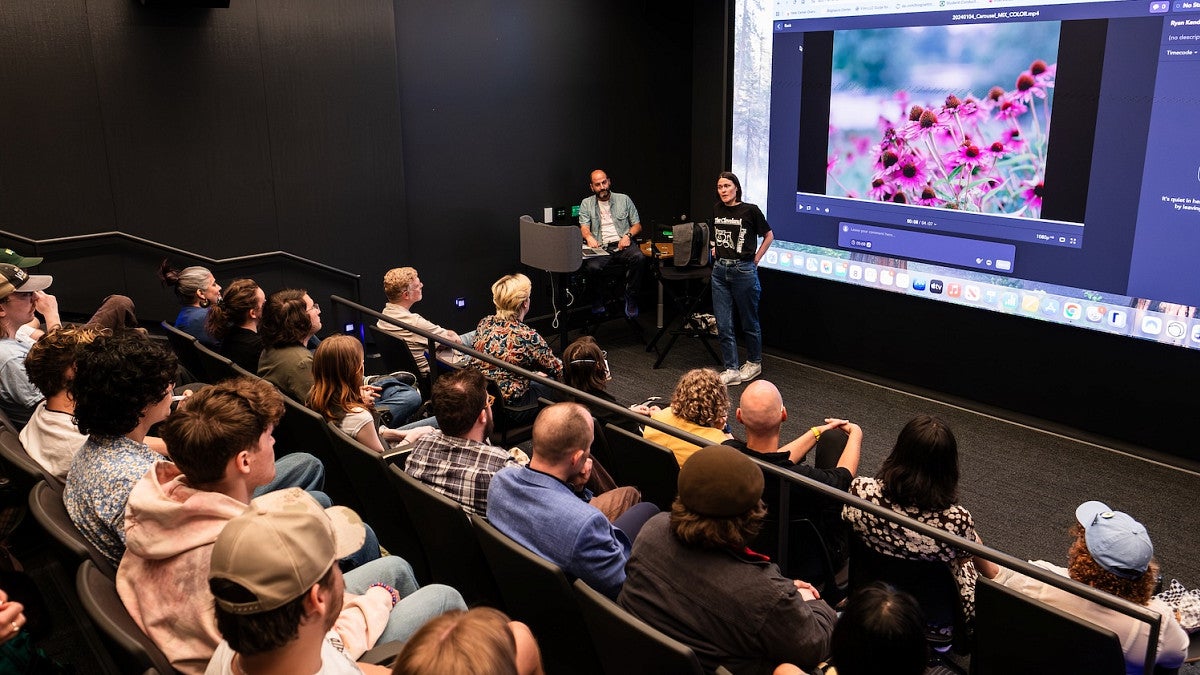
— Rachel Lambert, Director
In its 11th year, the Strauss Visiting Filmmaker Series featured director Rachel Lambert. She screened her 2023 film, “Sometimes I Think About Dying,” followed by a Q&A with the audience. The next day she offered a two-hour directing masterclass for students studying cinema studies. At both events, Lambert shared her process as a filmmaker, her professional journey and advice for cinema studies students.
Every year, the Harlan J. Strauss Visiting Filmmaker Series welcomes award-winning filmmakers to connect with College of Arts and Sciences cinema studies students through screenings, masterclasses and advice sessions. This opportunity offers students insight on how others in the field have developed and refined their voices as filmmakers. It also gives them a chance to interact with the filmmakers and ask questions about their processes and perspectives.
Meet director Rachel Lambert
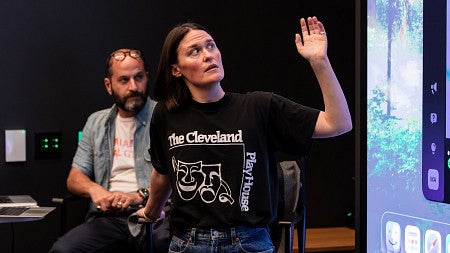
Though Lambert went to college for acting, she grew up curious about the art of filmmaking. Whether it was creating mini movies as a child, displaying short films made with friends at a Nashville bar, or working in film distribution, she shared that creating films has served as a method of answering questions she has.
During the masterclass, she shared that curiosity for filmmaking has led her to creative success, but she also highlighted the value of an education and her excitement for the opportunity to play a role in this for others.
“Education means a great deal to me in general. Anything that ever mattered in my life came from a teacher,” said Lambert. “If a school is full of people who care about film, and I could ever participate in cultivating and fomenting that care, then what an honor. It feels like a noble duty because I care that much about this art form.”
“Sometimes I Think About Dying” tells the story of an introverted office worker whose daily life is disrupted by a new co-worker. It was filmed in and around Astoria, Oregon, which made it a great fit for the Department of Cinema Studies’ 2026 film screening series, Filmlandia, which featured films with a unique connection to Oregon. Co-organizers of the series, Peter Alilunas and Colin Williamson, both professors in the Department of Cinema Studies, launched Filmlandia to enliven filmgoing on campus and to showcase the rich and sometimes overlooked history of film in the state.
While not an Oregonian herself, Williamson said Lambert embodied the spirit of the project perfectly.
“Lambert is remarkable for her willingness to give back to the community in ways that echoed what we sought to do with Filmlandia,” explained Williamson, who received the Tykeson Teaching Award this year. “She is also a model for the kinds of values — a commitment to craft and collaboration and a do-it-yourself attitude — that make independent filmmaking so vital nowadays, and that we hope to impart to our students as they navigate their experience of film at the university.”
Lambert’s other films include 2022’s “I Can Feel You Walking,” and “Carousel,” released in 2026.
Learning from a professional filmmaker
One piece of advice students Lambert gave during her masterclass was to invest in the humanness behind filmmaking. She said it’s important to invest in the humans who act in a film, in the humanness of the characters they portray and the humans that work behind the scenes to make a film complete.
To Lambert, humans are beautiful and foolish creatures. She said their ridiculousness is moving, and in her eyes, it deserves to be captured.
“There is drama everywhere, there is life everywhere, there is story everywhere, there are characters everywhere. The world is waiting for you to capture it, and that is very inspiring to me,” said Lambert.
Lambert also highlighted a few of her personal tenants in directing: find a cohort, believe in your individual process, dedicate energy to the details and learn from those who care enough to teach filmmaking.
She stressed the value in surrounding yourself with likeminded professionals. She has found that it is rare to find people who understand an individual’s creative process and are easy to mesh with and suggested to students that they stick with them once you find them.
“Something that stood out was she talked about improv on her sets, and I think that is somewhat rare to find in a director,” said Chloe LaMonica BA ’26 (cinema studies). “I really love that improv is implemented throughout her projects and will be doing the same in the future.”
Forging a career in filmmaking
Lambert said it’s equally as important to believe in yourself and your own process. Find it, cultivate it, reform it and own it. Sometimes the creative process, in the case of Lambert, is writing character backgrounds for each individual character to guide dialogue and demeanor. It’s showing love to each character as a human part in the overarching plot.
In terms of takeaways, Lambert hopes students understand that they are more connected to the filmmaking industry than they think. Having an idea and a willingness to explore it is half the battle.
“One thing I would like students to take away is for there to be less mystery around what it takes to make something out of an idea as a creative person,” said Lambert. “Most of what you need to make a piece of art already exists inside people, but it can feel mysterious and intimidating.”
Lambert’s masterclass fulfilled the unique opportunity the Strauss Visiting Filmmakers Series intends: If students have an idea or a question, then they can go out into the world and make a film about it.
“The impacts of Lambert’s filmmaking in Oregon and the time she spent with us this year screening and discussing her work will be long lasting,” said Williamson.
— By Gretchen Scheck and Jenny Brooks, College of Arts and Sciences