
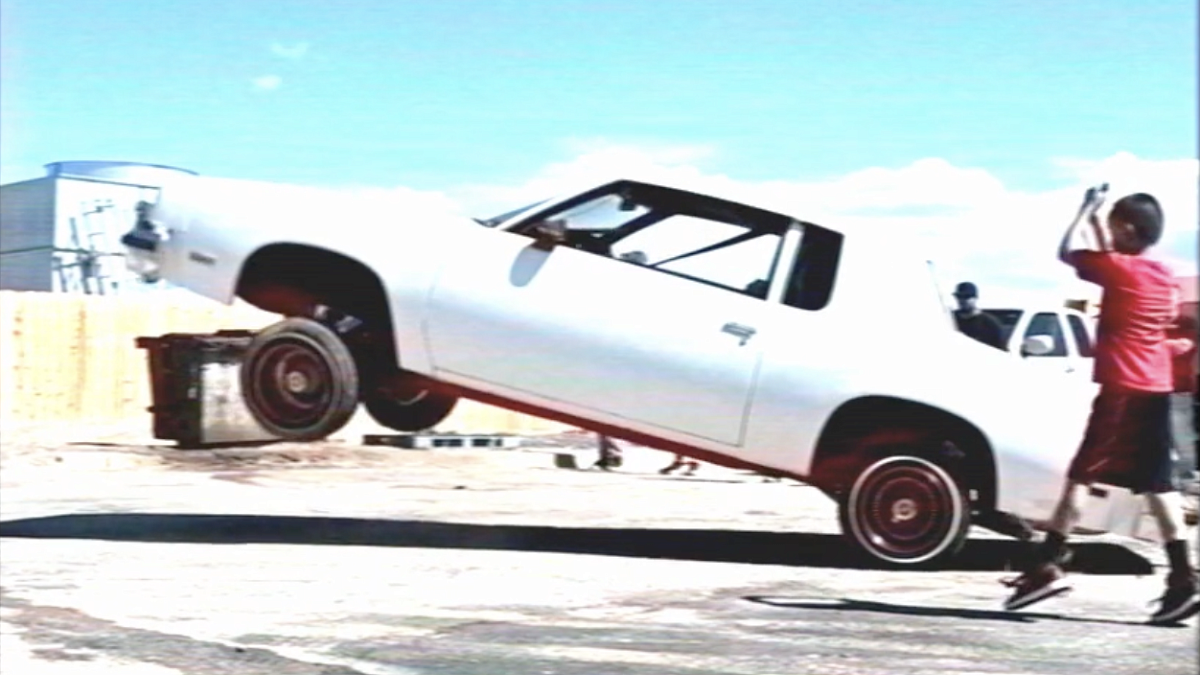
In the Española Valley of northern New Mexico, lowriding is the culture. Widely considered the lowriding capital of the world, the towns of Española, Chimayó and surrounding areas comprise the epicenter of lowriding culture where modified 1964 Chevy Impalas, muralism, generations of family tradition and religion intersect. All of it was recently captured in a documentary, “Holy Cars Sacred Hearts,” produced by a graduate student in the College of Arts and Science’s (CAS) folklore and public culture program.
When Alix Roederer-Morin, winter ’26, first entered the folklore and public culture master’s program, she was not set on analyzing car culture. She graduated from Concordia University with a bachelor’s degree in religious studies and a minor in fine arts. For graduate school, she was interested in research around the idea of people receiving messages from a higher power to create art, an idea identified by mainstream art media as outsider, self-taught or visionary art.
Roederer chose the folklore and public culture program at the University of Oregon because it’s one of the rare places in North America to offer an academic program in this field.
How does lowrider culture fit in the folklore and public culture area of study?
Roederer first became interested in lowrider culture when she was a teaching assistant for a course on car culture taught by Professor and Department Head Gordon Sayer. She learned about lowrider culture and found it aligned with her interests in vernacular, folk and community art, as well as in lived religion, or the ways ordinary people practice their religiosity. Then as part of a fieldwork course, she got in touch with the lowrider community in Northern Oregon, a connection that exposed her to the lowrider culture in Chimayó.
“Through the lens of folklore, I became very interested in car culture and the relationship people have with their cars. Especially in the US, which is a very car-centric culture,” said Roederer.
Making a documentary on lowrider culture
After summer in 2025, as Roederer and her dad drove back to Eugene from her hometown of Montreal, Quebec, Canada, they planned a pit stop in Española Valley to explore the car culture in person and carry out a personal project to make a documentary. One aspect of lowrider culture Roederer was most interested in was muraling, a sacred tradition in this area. The paintings on lowriders are meant to pay homage to beloved family members or serve as an expression of personal identity and religion.
Upon her arrival, finding people to include in this project was simple – many lowriders (drivers are also called lowriders) were eager to help with the project and share their culture. Roederer originally reached out to Joan Medina, co-owner of LowLow’s Lowrider Art Place in Chimayó, who used the tight-knit community to find more perspectives to fill the short film. Roederer spent 10 days around the lowriding capital and gathered 20 hours of film material representative of the culture.
When asked about why she chose documentary as the format for the project, Roederer noted the final project had to be seen. The visuals are as much of the story as the cars themselves.
“The cars need to be a part of the story,” said Roederer. “It doesn’t work with just the interview format or a written piece because you’ll miss the materiality of the car from that format. Them driving, hearing the motors, all of that is important to the story.”
Experiencing the cars, even if it’s on screen, is the point.
“Lowriding is an example of an art practice which functions ‘outside’ of the mainstream art world and concept of art,” Roederer said. “It has its own history, values, institutions, formal and conceptual codes.”
Though Roederer produced this documentary as a personal project, she hopes to include it as a chapter in her master’s thesis and showcase it in festivals or venues. She is also applying for grants for the opportunity to screen the documentary in Española. After receiving her master’s degree as a recipient of the Carol Spellman Fund and Award, she will be completing a fellowship with the Oregon Folklife Network, then hopes to receive an offer for a doctorate in sociology or anthropology.
Watch "Holy Cars Sacred Hearts"
— By Gretchen Scheck, College of Arts and Sciences