
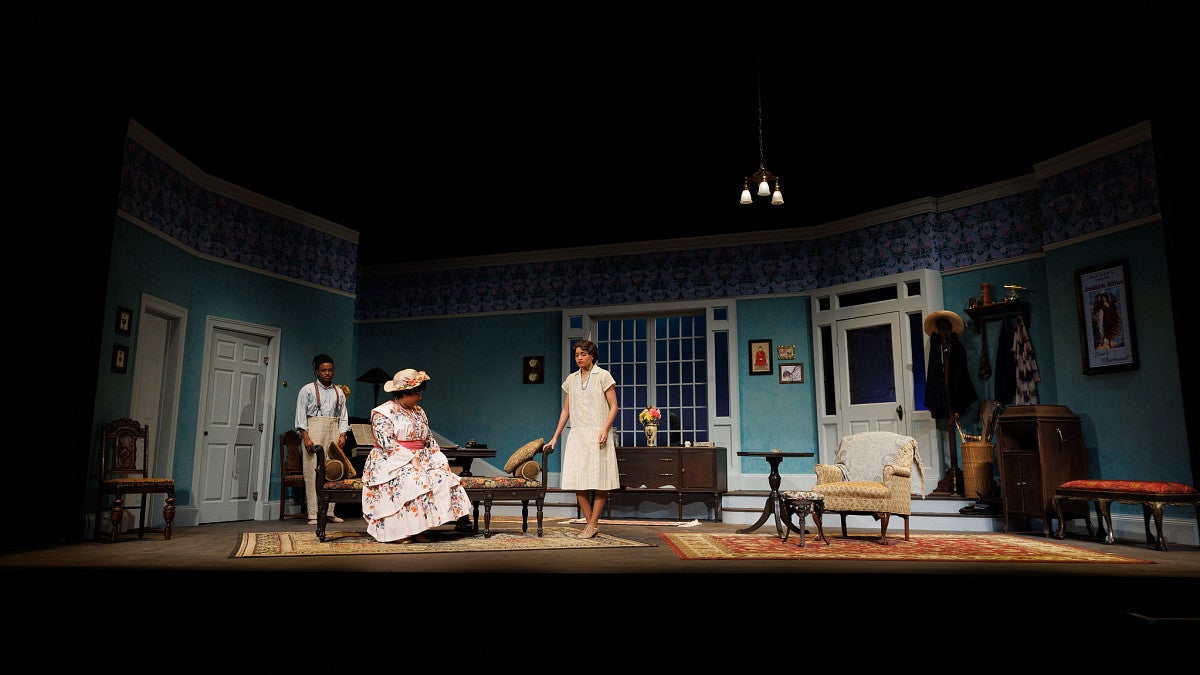
The Robinson Theatre is reopening this February with University Theatre’s winter production of Shakespeare’s “Much Ado About Nothing.” The reopening brings University Theatre’s largest performance space back into rotation, marking an important step forward for student training, production capacity and community engagement.
The Robinson Theatre, part of the Miller Theatre Complex, seats approximately 300 audience members and functions as University Theatre’s proscenium venue — a traditional stage that “frames” a production. The theatre was closed for two years during the renovation of Villard Hall which was completed in fall 2025. During the Villard renovation, the stage space was used for construction access, storage and offices, and much of its lighting system was offline.
“We once again have two functioning theatre spaces in our theatre arts complex, the Hope Theatre and the Robinson Theatre,” said Bradley Branam, senior instructor in theatre arts. “The Robinson Theatre seats 300. Whereas in the Hope, we can typically seat about 120 to 130.”
Beyond capacity, Branam praised the Robinsons’ educational value. “The Robinson Theatre is more of a traditional proscenium theater,” he said. “It is equipped with more of what you think of as traditional theater amenities. It has a fly system [the rope and pully system that lifts curtains, lighting and backdrops] and a trap section of the stage where we can send things below the floor.”
While the Hope Theatre’s black box layout allows for intimate and flexible staging, the Robinson offers students experience working at a professional scale. “Learning how to perform in a large venue, especially if microphones do not amplify you, is an important skill for any actor,” Branam said. “For our designers, I think working on a larger scale than you might be able to in the Hope Theatre allows the designers to imagine and fill the space a little more.”
The reopening also includes significant lighting upgrades. “They basically got rid of a lot of our old dimmers in the Robinson and replaced them with relays and new LED lighting instruments,” Branam said. “So some of the color shifting, some of the lighting possibilities for the show will be a little bit different than what we've had before.”
University Theatre chose “Much Ado About Nothing” to mark the reopening of the theatre in part because of its history and broad appeal.
“It's a show that's fairly well known, so we're hoping that we'll draw a large audience,” Branam said. “It's a fun show, particularly around the time that we're opening it, which will be Valentine's weekend.”
For Mary Jungels Goodyear, MFA ’05, a senior instructor in scenic design and the scenic designer for “Much Ado About Nothing,” the Robinson Theatre opens up creative and technical possibilities not available in smaller venues.
“Verticality, versatility and depth,” Jungels Goodyear said. “There’s more plasticity for a designer to model a sense of perspective when the audience is in front of a large picture frame.”
Hands-on training in a proscenium theatre plays a key role in preparing students for professional theatre work. “It’s important for students to learn about the inner workings of a fly system, operating a pin rail and working with automated lights,” she said.
She also emphasized what live performance in the Robinson means for the broader university community. “I'm most excited about collaborating with faculty, guest directors and working with students on the production design teams to share meaningful stories with the audience,” Jungels Goodyear said. “Live performance is meta and powerful as it lives and breathes. It's never the same show twice. You can't stop, rewind and see the same show again tomorrow night.”
Looking ahead, Branam sees the reopening as part of a long tradition of theatre at the university. “I think of the ongoing commitment of theatre arts on this campus,” he said. “There have been student and faculty groups producing theatre on the University of Oregon campus in or around Villard Hall for about 120 years.”
— By Harper Wells, College of Arts and Sciences