

A centuries-old Jewish legend tells the story of a clay figure brought to life to serve its creator — until it spins out of control and threatens the very community it was meant to help. Known as the golem, the folktale has lasted generations, shifting in meaning as the communities who tell it change.
One of the most widely known versions — the Golem of Prague, published in 1847 — is a defining version of the legend. Research from professors Gantt Gurley and Edan Dekel points to a community grappling with the limits of authority and the dangers of one person having too much power.
Gurley, an associate professor of Scandinavian for University of Oregon College of Arts and Sciences, and Dekel, professor of classics and Jewish studies at Williams College, met when they were in graduate school at the University of California, Berkeley. They have been collaborating on research about the Golem of Prague for more than two decades. Working together, they have traced the early origins of the golem legend and how it evolved over time. They’ve published their findings in three articles in The Jewish Quarterly Review: “How the Golem Came to Prague” (2013), “Kafka’s Golem” (2017) and “The Golem, the Ghost, and the Rose” (2025). Their work is also featured in a blog, “A Golem Trilogy,” for University of Pennsylvania’s Katz Center for Advanced Judaic Studies.
“About 25 years ago we were both discussing all these legends, and we knew the golem was a legend from Eastern Europe. And we wondered, ‘How does the Golem come to Prague?’ And then when we started looking at it, we found no one had mapped this out before,” said Gurley. “People had kind of hinted at what was happening, but no one had decisively put their finger on it. No one had figured out what was the earliest source.”
This mystery kicked off their initial investigation.
“We were interested in source, we were interested in how it relocates, but also correcting our understanding of how legend works,” he said.
The golem legend explained
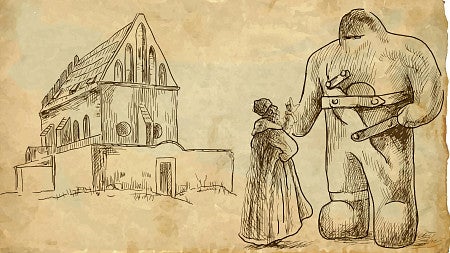
The golem legend starts with a rabbi creating a creature out of clay to help with household chores.
“Rabbis are very busy people. They need help. So, this rabbi creates a man out of clay to initially help with cutting the wood, getting the water, sweeping, the menial sort of chores that the rabbi doesn't have time to perform for himself,” said Gurley.
To animate the clay creature and put him to work, the rabbi slips a piece of paper inscribed with the name of God — a forbidden act in Judaism because no one is meant to speak or write God’s name. As the legend goes, in deference to the Sabbath, the day of rest in the Jewish religion, the rabbi removes the piece of paper, and the golem becomes a lump of clay again. But one Sabbath, for some unknown reason, the rabbi forgets or is too late to remove the piece of paper and the golem goes into a frenzy.
The rabbi has to pacify him and trick him to remove the piece of paper.
“The clay collapses and the rabbi promises he'll never do it again. But we're left with an artifact in the story meant to serve as a warning,” said Gurley. “In the Altneu Synagogue, the old synagogue in Prague, there is still a piece of clay that is believed to be part of the golem and none of the workers will touch it.”
According to Gurley’s research, the early golem stories reflect a community’s concern: what happens when one person commits a forbidden act. When the rabbi used God’s name to animate the golem, he was imitating divine creation, which was an unforgiveable overreach. Other examples of tales that serve as warnings include “Prester John” and Chaucer’s “The Pardoner’s Tale,” which warn about corrupt clergy.
Understanding the meaning of the story requires understanding where it came from and how it changed.
The source of the golem legend
How does an oral Yiddish folk story become what Gurley and Dekel say is perhaps the most famous of all modern Jewish literary fantasies?
To answer that, Gurley and Dekel combed through sources across languages and time periods, from medieval texts to modern scholarship. Together, they worked across dozens of languages looking for the earliest appearance of the story and how it spread.
The golem legend goes at least as far back as the 17 th century and is geographically based in Eastern Europe in the region of Poland. One of the earliest known German versions of the legend appears in 1808, in a story by Jakob Grimm.
The migration of the golem
Once they answered the question on source, the researchers wanted to learn how the story moved from Eastern Europe and how it changed as it did. Gurley refers to this process as ecotypification — the ways stories take on the details of the places they move through while keeping their core structure.
In the case of the golem, during the early 19 th century, the status and location of Jewish people changed, which affected the story. The first written versions were in Eastern Europe and assigned to a more mystical figure and associated with Kabbalah, an older mystical branch of Judaism. When the legend arrives in Prague, the rabbi in the Golem of Prague is diplomatic, community minded, an intellectual. The figure becomes less mystical and more socially minded, which reflects the needs and anxieties of a changing community.
As different writers put their own touches on the golem, it is finally tied to Rabbi Judah Loew. When it was published in Leopold Weisel’s “Der Golem” in 1847, it became the standard version and subsists for the next 60 years.
Why folklore matters
Folklore isn’t just stories — it’s a historical record. Gurley explained that legends reflect the culture and mental state of a community, offering explanations for how communities think, what they fear and how they understand the world. The Golem of Prague was a direct reflection of the community pushing back on authority.
Folklore also helps people make sense of unfamiliar or threatening developments. In the early 20 th century, the golem legend morphed from a warning about too much authority to being a protector.
“That's when you get Golem as protector of the Jewish ghetto. And while that was not the original point of the legend, that shifts because there's a shifting psychological need towards the 20th century,” said Gurley. “You need the superhero. You need the great protector.”

Gurley notes that this later version of the golem — as the protector — likely influenced modern ideas of the superhero, as seen in 20th-century figures like Superman and The Thing. Through their creations, Stan Lee and Jack Kirby, both Jewish, demonstrate their familiarity with the golem legend.
Gurley expects the golem legend to continue to evolve to meet the needs of a community and raise questions about power and control. He points to the rapid development of artificial intelligence with little to no guardrails and scientific experimentation around human longevity as issues primed for development of golem-level legends.
Their work is far from finished. As they turn to studying how Jewish legends were collected into anthologies, Gurley and Dekel continue to ask the same underlying questions: where do stories come from, how do communities shape them and why do they endure.
— By Jenny Brooks, College of Arts and Sciences