
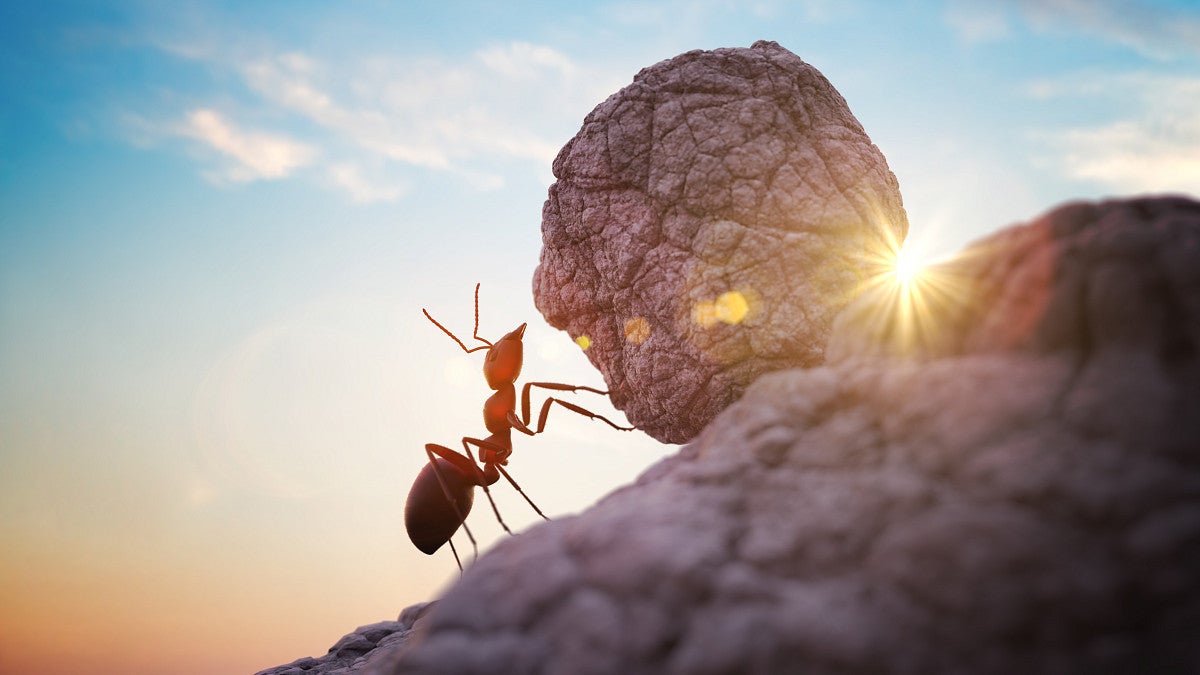
In fiction, a writer can take any character's perspective to tell a story. Even an ant's! And that is exactly what English major Sara Twiggs ’26 did for her short story, “If an Ant Could Write,” which she submitted for a flash fiction competition on the National Day of Writing.
The College of Arts and Sciences' (CAS) Writing Composition program and the Department of English combined efforts to celebrate the National Day of Writing this past fall. The celebration, established by the National Council of Teachers of English, focused on the cognitive value of writing and reading and encouraged students to “power up your writing brain.” The day’s events included the flash fiction competition, a scavenger hunt with a chance to earn prizes, public writing spaces where students could respond to writing prompts, and librarian-led workshops in Tykeson Hall on blackout poetry, calligraphy and zine making.
"We wanted to use the event to promote both the cognitive value of writing, which seems increasingly necessary with the ever more widespread use of AI, and the writing resources across campus that are available to students,” said Michelle Stuckey, director of composition and associate teaching professor.
The flash fiction competition invited students to submit a story that was: 1) less than 1,000 words; 2) an original fiction piece that featured a writer or an act of writing; and 3) written by an English major with no AI in the drafting or writing.
"Good writing — in whatever circumstance or genre — often looks effortless but is a hard and painstaking skill to acquire,” said Mark Whalan, Robert D. and Eve E. Horn Professor of English and head of the CAS English department. “We wanted to make that visible but also to celebrate the writerly ingenuity and talent of our students, which the competition certainly delivered.”
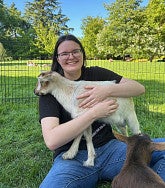
Twiggs’ story earned her a $50 gift card to The Duck Store, a feature in the weekly English email and a space to display the story outside the English department’s office for the year.
“I am interested in putting my writing out there more, either through contests or publications, and this seemed like a great first step,” said Twiggs. “The story was also inspired by the work I’ve been doing with posthumanism in a few of my classes. I find it really interesting to de-center the human perspective and consider new ways of thinking and being.”
Read Twiggs’ winning story below.
If an Ant Could Write
A fiction short story by English major Sara Twiggs ’26
If an ant could write, it mostly likely would not. This is because our current pens are far too large for an ant to use, to say nothing of the paper. An ant, could it write, would be crushed beneath the weight of its pen before it could jot down a single word.
If we made a pen small enough for an ant to write with, it still would be unable to. Even if it were scaled down to the appropriate size, the design of such a pen would still favor an individual with fingers and at least one thumb. An ant, possessing neither, could try to hold it between its mandibles, but as they lack the required dexterity to do anything more than scribble, the whole affair would be rather frustrating for both ant and observer.
If an ant could properly maneuver a pen, be it through innovation to the pen or ant, it still, of course, would be unlikely to write. Ants communicate primarily not through sound, but through pheromones. Transcribing sounds into words is a limited form of translation, but we cannot even fathom what would be lost in the linguistic translation of smells. The way an ant communicates – and thereby thinks – is so far removed from human language that even if we gave an ant the ability to speak and comprehend English words, it might not even be able to connect our words to its understanding of the world. For every concept introduced with each word – to have, to know, to love – there is no reason to think that an ant would even have a point of reference for those ideas. To presume otherwise indulges the instinct to anthropomorphize, funneling the experiences of an ant through our own perspective. It is a horridly self-centered and deeply human thing to do. But let us do it anyway.
If an ant could understand and think in human language, if we made a pen that its thumbless feet could yield and scaled it down to size, what would an ant write about? Maybe it would journal about its day— the best crumbs it found or how another ant was rude to it. Maybe it would write about its friends (would an ant have friends?) or the power of the queen. Or maybe it doesn’t like the queen. Maybe it would write a manifesto against her and distribute it to all its workers, and there would be a great revolution that the ant could later write down so the other ants remember their collective power. Or maybe it doesn’t think of itself as an individual, but an extension of the colony. It could write in “we” and “us” instead of “I” and “me,” and everything it does is the equivalent to the finger twitch of a larger, more complete animal.
If an ant could write, would it speculate? Would it imagine? Maybe it would write itself as a hero, or make up new ones, brave ants who heroically sacrifice themselves for the betterment of the colony. Maybe it would write stories of disease and its survivors trying to rebuild the community, or attackers who chase and hunt. What would horror look like to an ant? What would fantasy? Maybe it would imagine a bright future for ant kind where they are no longer forced to live underground and there is always enough food and they are never afraid of bugs or poisons or people. Maybe the ants tell these stories to each other already.
There is an impulse to say that an ant would write about what it might be like to be human, but this is not very likely. Afterall, how often do you wonder what it is like to be an ant?
And speaking of people, what would we think of an ant’s writing? Imagine, upon the recommendation of a friend or coworker, going to the bookstore and picking up the tell-all memoir of an ant. What would it mean for us that something so small and insignificant could do something as big as writing. Maybe we would try to cover up its writings, both for our own egos and for ethical concerns. How could you call the exterminator on an ant writing about how bountiful the food is in your kitchen? How could we kill anything ever again if an ant were capable of writing?
Just maybe, we could learn something from the writing of an ant. Maybe such a radically different perspective is what we need to put ourselves in check. If we understood how an ant saw the world, maybe we could better understand how we see the world. Maybe the ant would tell us of the beauty of harmony and seamless connection. It could teach us the importance of fastidious work, but also of what it means to be a part of something. If an ant could write, maybe we could take its lessons and use them to fix our own problems and end our own wars and create our own close-knit communities and slowly, gradually, shape a better world.
Of course, all this speculation is quite frivolous, as an ant cannot write.
— By Jenny Brooks, College of Arts and Sciences