
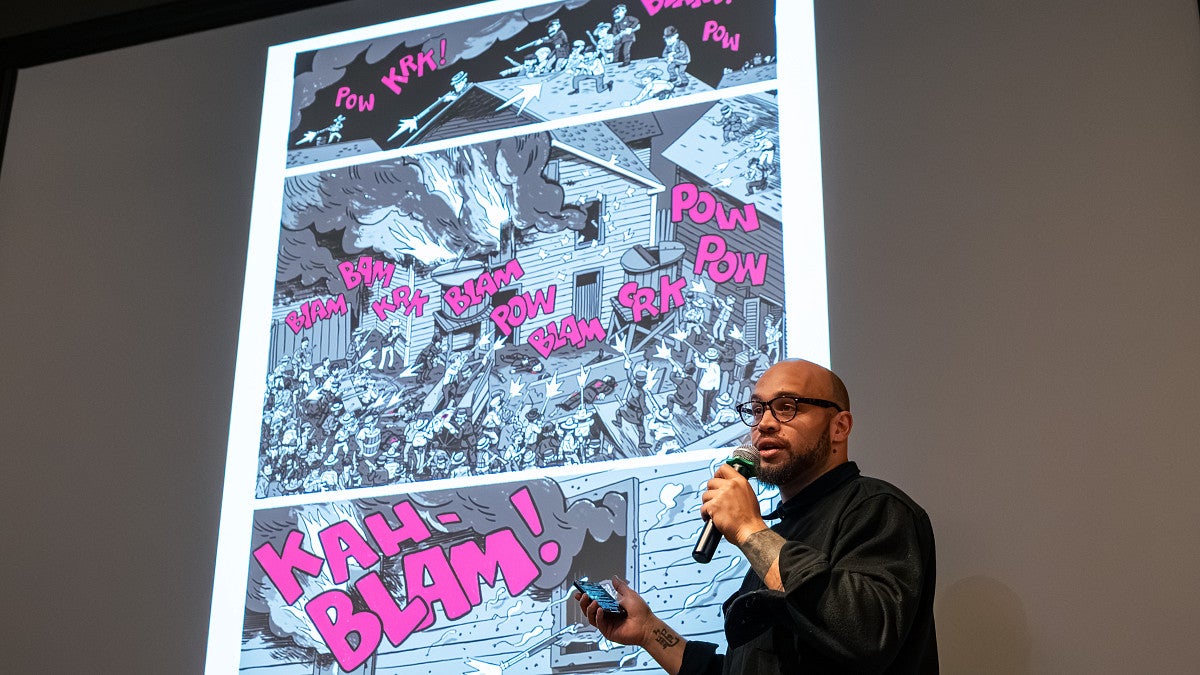
At the end of an evening’s public talk in the Jordan Schnitzer Museum of Art, a student stood up and asked the speaker, “Why did you use that red?” The question appeared to leave the speaker, political comics artist Ben Passmore, at a loss for a moment. He was there to talk about his latest graphic novel, “Black Arms to Hold You Up,” which primarily uses three colors: black, white and a pinkish-red. While the question seemed simple, the answer was not.
“There's always a percentage of the students who are very curious and ask questions that are so simple — not in a bad way — that they are challenging,” said Passmore, a professional comics artist who writes about politics and activism. “And that feels like a really good opportunity to justify my work because they have no reason to flatter me. I appreciate how curious they are, and they're very earnest.”
Kate Kelp-Stebbins, associate professor and director of the Comics and Cartoon Studies Program in the College of Arts and Sciences (CAS), invited Passmore to speak and share his perspective at an open community event and in one of her classes, Introduction to Comics Studies. Visits from guests like Passmore help students in comics and cartoon studies broaden their perspective on how they can use their art. It also gives them a real-world understanding of what they’re studying in class. For guest lecturers, it’s a chance to get feedback on how others are receiving their work.
“Our program prioritizes bringing artists to classes so that students have a chance to engage creators directly about their work,” said Kelp-Stebbins. “Students always describe these visits as the highlight of class because the artists provide such great insights and illuminate the creative process.”
Going beyond the technicalities to tell a good story
The CAS Cartoon and Comics Studies Program doesn’t just focus on the technicalities of how to draw. Students learn history, research and storytelling, something Passmore is 100% behind.
“Storytelling is, to me, the most important social skill,” he said. “A story is a thing you share. It's not a performance, or at least it shouldn't be. It's not a selfish act. It's a bridge. And that's always felt deeply important.”
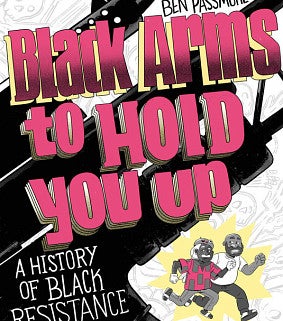
In “Black Arms to Hold You Up,” which tells the stories of Black militant movements and Black militant figures over the last century or so, he used a father and son as main characters and narrators. The relationship is a relatable theme meant to enhance the stories and carry readers along.
Making a career in comics
Passmore moved to New Orleans after college and lived as a squatter and in communes. He’s also an anarchist and spent the early years of his career creating comics that served as commentaries on what was happening in alternative communities, such as the punk scene. He didn’t follow a straight line to becoming a published author, but he had a love of the art and a desire to contribute to Black culture. These motivated him to continue to create, even when friends or partners suggested he give it up.
“No one was reading my comics for a long time, so I think in some ways, I benefited by the fact that I wanted to do this thing, but no one was really paying attention,” he said. “So then to keep doing it, I was like, ‘Well, what am I doing?’ If I'm not doing this for myself, who am I doing it for?”
Even when his work wasn’t popular, he was able to put criticism aside. He anchored himself in his community to stay grounded. He also found martial arts and running as outlets that helped him feel good.
“In general, critique hurts when we already feel really bad about ourselves and we're feeling really shaky about our self-identity,” he said. “Something I had to learn was that me pressuring myself, like negative motivations, doesn't produce good work. I had to think of my brain as an engine to give good fuel to.”
As he developed his voice, style and perspective, he started to find an audience. He attended independent comics conventions and met fans of his work. It gave him early experience talking about his work and hearing how it affected people.
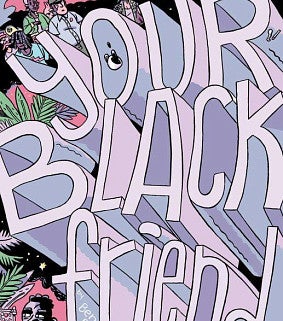
Then his graphic novel, "Your Black Friend,” received an Ignatz Award in 2017. It won the award for "Outstanding Comic" at the Small Press Expo, was listed on NPR's list of 100 favorite comics and graphic novels and was nominated for an Eisner Award. He’s had to adjust to having more readers, including reviewers, which impacted the development of his next book, “You Are a Riot,” a collection of nonfiction comics journalism scheduled to come out in 2027.
“I think I feel much more responsible for what I talk about and how I talk about it now.”
Guest lecturers are a win-win
So, why did Passmore use that red in “Black Arms to Hold You Up?”
“It’s a salmon red meant to represent militancy. It’s something you can’t ignore,” said Passmore. “I wanted to evoke a connection to old propaganda posters from the 1940s and it was a way of drawing attention to certain characters, marking them with struggle.”
While the question was simple on the surface, Passmore knows students to be close readers. Their questions are curious, not judgmental, and that helps him reflect on his work. He feels students and guest lecturers learning from each other is the best-case scenario.
— By Jenny Brooks, College of Arts and Sciences