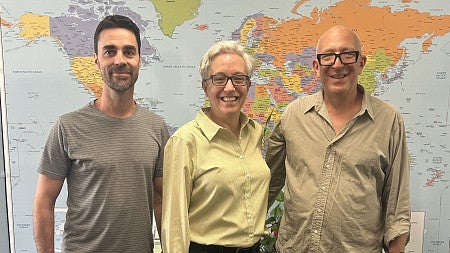
The Department of Religious Studies is an interdisciplinary program that spans a variety of departments, including Asian Studies, Medieval Studies, and Middle East and North African Studies. Our award-winning researchers engage in grant-funded research and have authored many publications.
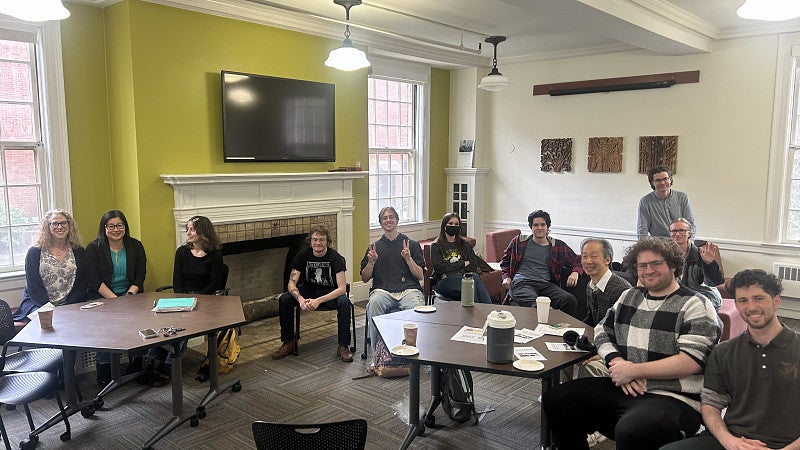
Religious Studies Poster Session featuring the research of students in "REL 411 Making Sense of Religion.”
On Friday, March 13, 2026, Religious Studies faculty and students gathered in Susan Campbell Hall for the first annual Religious Studies Poster Session featuring the research projects of students in "REL 411/511 Making Sense of Religion." REL 411/511 is a capstone, seminar-style course required for all Religious Studies majors, but open to any juniors, seniors, or graduate students who have taken at least two prior courses in religious studies. In the course, students trace the history of the study of religion from the late 19th century to the present, examining works by philosophers, historians, sociologists, psychologists, anthropologists, and theologians while grappling with fundamental questions such as: What is religion? What are the origins of religion? What psychological or social needs do religions fulfill?
Among the student presenters were juniors Katie Lauck and Sam Dody. Katie Lauck, who is double-majoring in Religious Studies and Human Physiology, presented a project titled "Sacred Boundaries: Christianity and the Politics of Belonging" that examined the historical role of Christianity in defining social boundaries in the United States, including boundaries between citizens and immigrants. Sam Dody, who is double-majoring in Religious Studies and Art, presented a project titled "National Axis Mundi" that investigated how religious patterns persist in modern, capitalistic societies in the form of totemic, monumental buildings like the Burj Khalifa tower in Dubai.
Faculty and students in attendance discussed these and other student research projects, reflected upon core ideas and readings from the capstone course (especially Edward Said's Orientalism and Timothy Fitzgerald's The Ideology of Religious Studies), and brainstormed together about new religious studies initiatives.
Research Areas
Jeff Schroeder
Associate Professor
Research interests: History of Buddhism in 19th- and 20th- century Japan, especially of the Jōdo Shin sect; Buddhism and World War II; Buddhism, science, and philosophy; democratization of Buddhist institutions; experimental Buddhist communities
Deborah Green
Associate professor
Research interests: History, literature, and interpretation of the Hebrew Bible, particularly as it was adopted and interpreted by Jews from the Second Temple through Byzantine periods
Luke Habberstad
Associate professor
Research interests: Literature, religion, and material culture of early China (5th century BCE-3rd century CE); early Chinese historical writing; excavated texts; politics and cultures of dynastic and monarchical courts; ancient empires; and religious ritual
David Hollenberg
Associate professor
Research interests: How communities of believers apply narrative, doctrine, and ritual to form and maintain communal identity and to differentiate themselves from those outside their group. He applies such questions to research on Nusayri Shiism and medieval Islam
Stephen Shoemaker
Professor
Research interests: Ancient and early medieval Christian traditions, especially early Byzantine and Near Eastern Christianity. His research focuses on early devotion to the Virgin Mary, Christian apocryphal literature, and the relations between Near Eastern Christianity and formative Islam
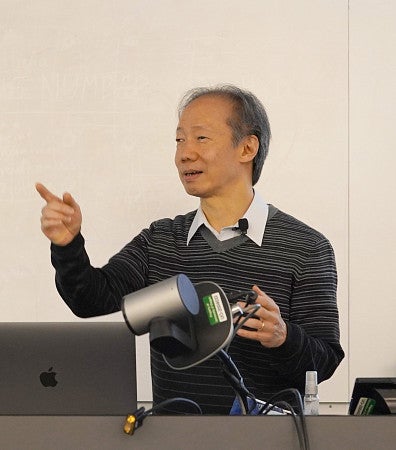

Much of what shapes the world appears to be non-religious, including the global economy, science and technology, and major shifts in the natural world such as climate change. Yet, religions continue to play a major world in shaping the contours of society and culture as well as our views about science, technology, nature, and commerce. On the one hand, religious studies represents the objective, historical study of a wide array of religious streams and phenomena that help us to understand how human beings view and shape the world. On the other, we begin to understand how human beings have sought answers to the big questions of existence: What is human nature, what is our place in the world and the universe as a whole, as well as how we face difficult questions of suffering and death that science and technology often seem unable to resolve. Exploring the wider world and inner questions of existence together with students has been an incredibly rewarding journey as a scholar and a teacher.
—Mark Unno, professor of Religious Studies
Interdisciplinary Research
Religious studies is interdisciplinary by nature, and our faculty often engages in research across multiple disciplines.
Interdisciplinary Opportunities

Religion reflects attempts to create and recreate meaning in societies over time. Translating the most ancient hymns, documenting devotion to Mary in early Christianity, studying emergence of Islam in its earliest days – my work reveals how communities search for an elevated purpose amid changing cultural forces. Anchored in moments that unfurl into histories, their search helps us understand the influence of religion in society. It is hard to find a more timely topic, or a more timeless one. It is a great privilege to be a part of the University of Oregon’s vibrant and diverse scholarly community. Endless opportunities to learn and exchange perspectives on our shared past – what more could a historian want?
—Stephen Shoemaker, professor, religious studies
Published Research
Read the latest research from the Department of Religious Studies.