

Comparative Literature, published by Duke University Press, is widely recognized as the leading journal in its field and a cornerstone of humanistic scholarship. Consistently ranked among the world’s top literature journals, it combines exceptional scholarly impact with a broad global readership and influence.
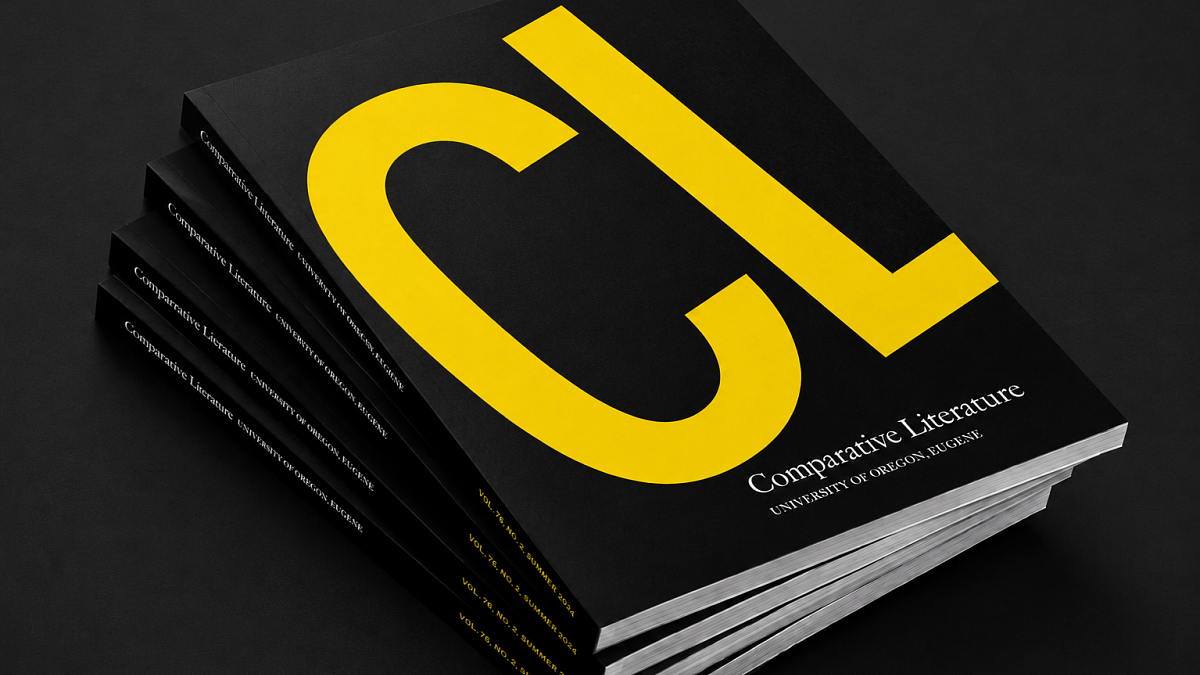
Founded in 1949, Comparative Literature is widely recognized as the oldest journal of comparative literary studies in the United States. The journal now circulates globally through a publishing partnership with Duke University Press, but the University of Oregon remains its administrative home and has served as its intellectual steward for nearly eighty years. This sustained institutional commitment has made Oregon a recognized international center for the discipline.
The journal originated from a 1947 proposal by Professor Chandler B. Beall to UO President Harry K. Newburn, addressing a need identified by American comparatists for a journal to succeed the French Revue de littérature comparée, whose publication had been disrupted by World War II. Newburn agreed to finance the journal, on the condition that UO retain full ownership and editorial direction, supported by a national Editorial Board nominated through the Modern Language Association. The first issue appeared in spring 1949.
Under stable leadership, Comparative Literature grew from a regional venture into a journal circulated to scholars and libraries in roughly 50–70 countries, including institutions across Eastern Europe during the Cold War. The journal published foundational work by scholars such as René Wellek, Erich Auerbach, and E. R. Curtius, and helped establish comparative literature as a recognized academic discipline in American universities. The journal’s success directly enabled the University to launch a doctoral program in Comparative Literature, approved in 1962, which drew on faculty across the English and foreign-language departments and was later supported by National Defense Education Act fellowships for graduate study abroad. The journal and the academic program developed in tandem, with the journal serving as Oregon’s principal scholarly ambassador to an international community of comparatists.
Beall edited the journal for more than two decades, a tenure of unusual stability that anchored both the journal’s reputation and UO’s standing in the humanities. Editorial leadership later passed to Thomas R. Hart, who maintained an exceptionally rigorous review process and guided the journal’s engagement with structuralism and literary theory. Subsequent editors — Steven Rendall, George Rowe, and currently Michael Allan — have steered the journal through the rise of postcolonial criticism, translation theory, and world literature, while keeping it embedded in Oregon’s interdisciplinary humanities community.
For nearly eighty years, the University of Oregon has owned and edited one of the central institutions through which comparative literature was built as an academic discipline — from its 1947 founding agreement to today’s globally circulating publication. Few humanities programs anywhere can claim comparably continuous stewardship of a publication so central to an entire field’s intellectual development. Comparative Literature stands among UO’s most significant and enduring contributions to international humanities scholarship.